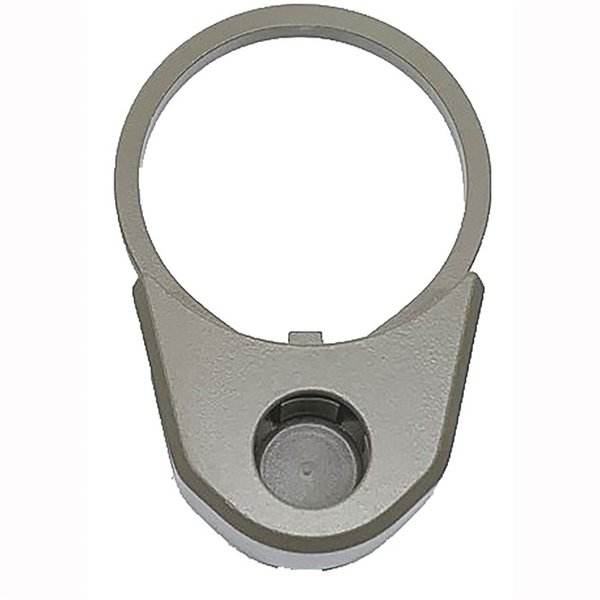
AR-15 END PLATE W/ 3-QD SLING SWIVEL SOCKETS STEEL As is FCD’s practice, ESF’s shape is dictated by its functions. In order to accommodate the rear facing socket, and fill one of the design requirements that ESF must be able to use stakable castle nuts and allow the carbine stock to fully collapse, ESF has a slight increase in width on the sides, and small openings on the top of the sockets housing. These design cues do not affect ESF’s structural integrity, and mostly go unnoticed by users, they merely reflect a paradox, that it can be quite complicated to create a simplified design. A seemingly simple product can often be more than meets the eye. End plate sling adapter for ARs Side and rear facing sockets Billet 4140 DLC Black or FDE Cerakote finishes NOTE: End plates that incorporate side facing QD swivel sockets can mask available wrench notches required for torquing. A conventional castle nut wrench has 3 lugs, in some cases, the socket housing may partially block access to one of them. A 2 lug castle nut wrench, such as the AR Multitasker, or our JCW (Joint Castle nut Wrench) would be required to torque the castle nut properly. ESF's receiver extension indexing tab can be tight on some receiver extensions.
Scopri l'innovativo End Plate per AR-15 con 3 socket per sling QD!
Il AR-15 END PLATE W/ 3-QD SLING SWIVEL SOCKETS è progettato per offrire funzionalità e versatilità. Segue la pratica di FCD, dove la forma dell'ESF è dettata dalle sue funzioni.
Caratteristiche principali:
- Adattatore per sling end plate per AR
- Socket laterali e posteriori
- Realizzato in Billet 4140
- Finiture disponibili in DLC Black o FDE Cerakote
Per garantire l'utilizzo di castle nuts impilabili e permettere al calcio del carabina di collassare completamente, l'ESF presenta un leggero aumento della larghezza sui lati e piccole aperture sulla parte superiore degli alloggiamenti dei socket. Questi dettagli di design non compromettono l'integrità strutturale dell'ESF e spesso passano inosservati dagli utenti, riflettendo un paradosso: può essere piuttosto complicato creare un design semplificato.
Nota: Le end plate che incorporano socket QD rivolti lateralmente possono mascherare le notches della chiave necessarie per il serraggio. Una chiave per castle nut convenzionale ha 3 lobi; in alcuni casi, l'alloggiamento del socket può parzialmente bloccare l'accesso a uno di essi. Sarà necessaria una chiave a 2 lobi, come l'AR Multitasker o la nostra JCW (Joint Castle nut Wrench), per serrare correttamente il castle nut. Il tab di indicizzazione dell'estensione del ricevitore dell'ESF può essere stretto su alcune estensioni del ricevitore.
 Aiuto e contatti


 Newsletter




 Visualizzazione classica
 Visualizzazione mobile